15 interactive explorations
Move something.
See what follows.
Space, physics and patterns you can play with. Change a condition, make a prediction, then see what follows.
Light that bends, constellations that come apart, planets with unfamiliar days and patterns that grow from small disturbances. Each exploration is a place to try an idea, with the model and its limits alongside it.
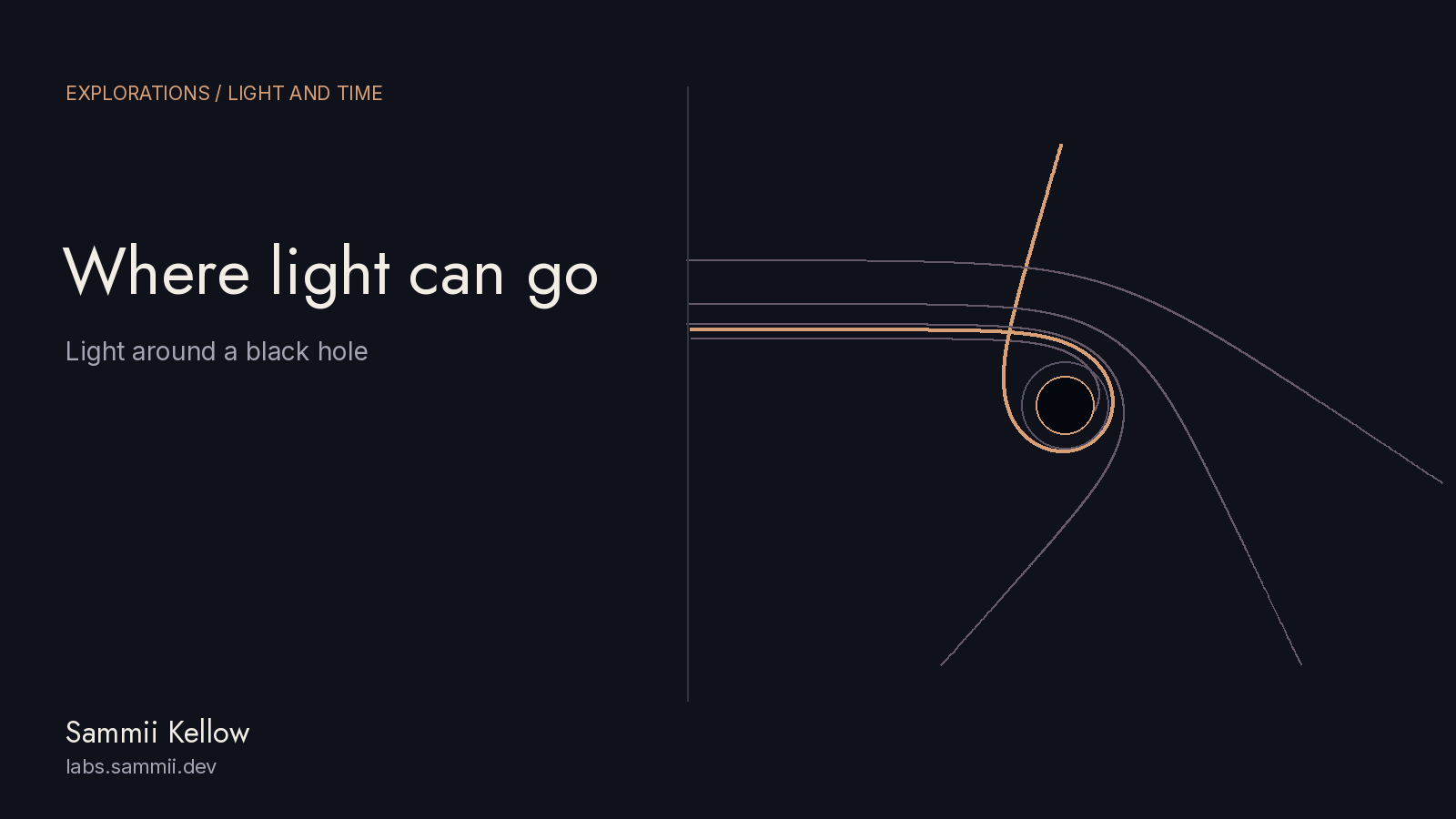
Where light can go
Move the aim of a light ray by a little. Watch its route change from a gentle bend to a long turn, then to capture at the horizon.
Explore light around a black holeLight and time
Gravitational time dilation
Near a black hole
Place a stationary clock near a non-rotating black hole and compare its rate with a distant clock. Change the radius and watch the difference accumulate.
Open explorationLight around a black hole
Where light can go
Aim light past a black hole and find the boundary between escape and capture. Trace and scrub calculated Schwarzschild paths with readable model limits.
Open exploration
Quantum
The double-slit experiment
One arrival at a time
Build an interference pattern from individual detections. Change wavelength and slit separation, then compare indistinguishable paths with a path record.
Open explorationQuantum tunnelling
Through the forbidden
Change an electron's energy and a rectangular barrier's height and width. Compare transmission and the matched stationary wavefunction across the barrier.
Open explorationQuantum uncertainty and wave packets
A little less certain
Squeeze a Gaussian wave packet, compare position and momentum spreads, then release a free electron and watch the position distribution broaden.
Open exploration
Worlds
Plate tectonics
A planet reshaping itself
Scrub through diverging plates, subduction and transform faults. Explore how geological processes reshape a landscape in three interactive illustrations.
Open explorationPlanetary skies and light
A day on another world
Move from dawn to dusk on twelve planets and moons. Compare artistic surface and atmospheric views, from Mars's sunset to Titan's diffuse haze.
Open explorationPlanet and moon interiors
Beneath the surface
Reveal the layers inside twelve planets and moons. Inspect rock, ice, ocean and fluid regions in simplified models with their uncertainties explained.
Open explorationGravity across the Solar System
The gravity room
Launch the same object on twelve worlds and compare its path. Play, pause and scrub a shared clock, then inspect height, distance and vertical velocity.
Open explorationPlanetary surface evolution
Worlds in Time
Grow a synthetic planet or moon through impacts, cooling and surface renewal. Scrub its calculated history, change the conditions and place an impact.
Open exploration
Skies
Constellations and attributed sky stories
One sky, many stories
Explore 88 modern constellation figures in stars, lines or illustration. Compare separately attributed Matariki, Seven Sisters and Celestial Emu accounts.
Open explorationStellar proper motion
The sky unravelling
Scrub through an illustrative future and past for 88 constellations. Compare measured stellar proper motions with the original pattern and inspect the data.
Open explorationConstellation depth and viewpoint
Step outside the pattern
Move sideways from Earth's viewpoint and see the Big Dipper change. Explore a seven-star sample using Hipparcos positions and measured parallaxes.
Open exploration
Sound and pattern
Vibrating membrane modes
The shape of a note
Explore the still lines inside a vibrating square membrane. Blend equal-frequency modes, inspect nodes and optionally hear a synthetic tone.
Open explorationReaction and diffusion
Patterns that grow
Paint into a Gray–Scott reaction–diffusion model and watch spots, stripes and branching forms emerge. Change feed and removal rates, then compare outcomes.
Open exploration